
City lots, old trees, and a curb strip that belongs to City Hall
Tree Removal in Buffalo, NY
Careful takedowns between houses, garages and wires, with clear answers on which trees are yours to remove.
- Free estimates, in person, for homes in Buffalo and Erie County
- Line-item quote you can compare
- Wood, brush and stump plan settled up front
Removing Trees in the City Itself
Tree Removal in Buffalo starts with a question most suburbs never ask: whose tree is it? Under Chapter 467 of the City Code, a street tree is one planted in the public right-of-way, and that includes the grass strip between the sidewalk and the curb. Those trees belong to the city. The maple shading your porch from the tree lawn is not yours to cut, even if it drops limbs on your car. The silver maple in the backyard, the box elder growing out of the fence line, the spruce crowding the driveway: those are on your lot, and that is where we work.
What the city handles, and how to ask
The Bureau of Forestry maintains street trees and trees in parks and city-owned lots. Residents reach it through 311, by phone or online, to request an inspection, a removal or trimming, a planting, a root or sewer conflict, or a pest or disease concern. If a street tree looks dangerous, call 311 first and document it. The city also publishes a street tree inventory map and a block pruning map, so you can see whether your block is already on the schedule.
Residents are allowed to care for street trees in small ways. Section 467-3D lets a resident trim and prune with Forestry Office approval, but only with hand tools: no chainsaws, no motorized equipment and no ladders. Anything bigger is city work or permitted work. Damaging or removing a public tree without authorization can bring a fine of up to $1,500, up to 15 days in jail, or both, under Section 467-5.
Private trees on narrow lots
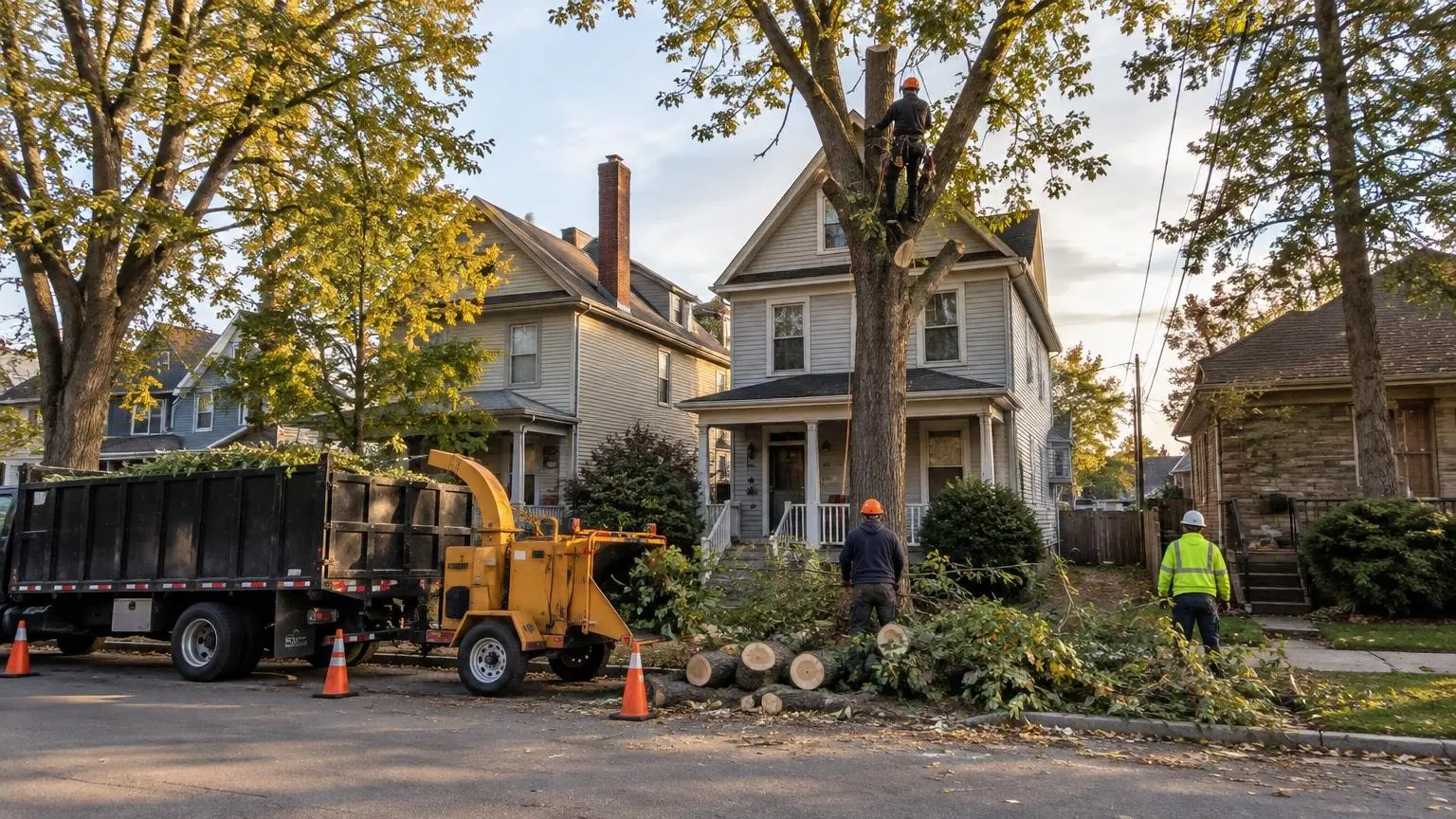
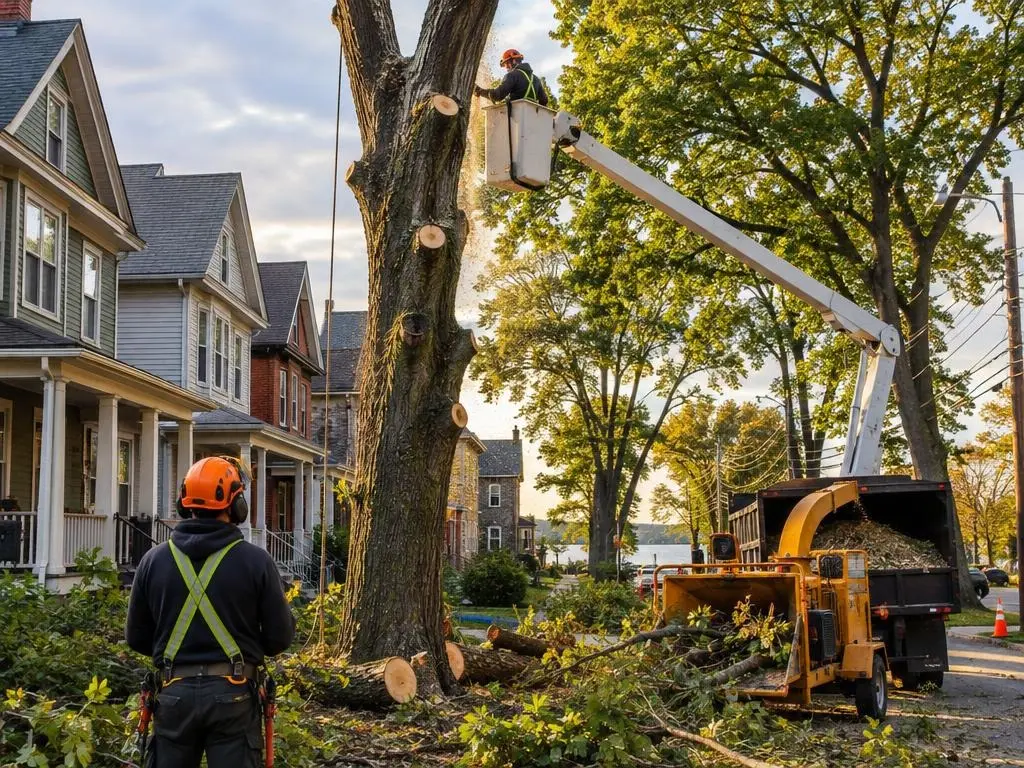
Buffalo was built out long before modern setbacks. Many homes sit a driveway's width from the neighbor, with a detached garage at the back and service wires crossing the yard. A tree in that setting rarely comes down in one piece. We take it apart from the top in sections, lower heavy wood on ropes so it lands where we planned, and keep it off roofs, fences and the neighbor's car. When there is no room to drop anything at all, a crane can lift pieces over the house to the street. We will tell you on the walk-through which method fits your yard and why.
Before we cut near the wire that runs from the pole to your house, that wire needs attention. National Grid, which serves the city, trims around its primary lines on a cycle, but the service drop to the house is the owner's responsibility. National Grid asks owners to call customer service at least five days ahead so the line can be temporarily disconnected or covered with rubber sleeves.
The storms that shaped the canopy
On October 12 and 13, 2006, the storm the Weather Service later documented in detail dropped 22.6 inches of snow at the airport and about 20 inches in North Buffalo onto trees still in full leaf. The city's own parks were hurt; Olmsted landscapes such as Delaware Park, roughly 350 acres, lost trees to that storm. Many of the backyard trees that survived carry the evidence today: old tear-outs, stubs where limbs broke, and decay that has had nearly two decades to work inward. Those are the trees we look at most carefully.
Emerald ash borer has added a second wave. Public broadcaster WBFO reported in 2016 that dying ash were being removed from Shoshone Park and city streets, decades after Dutch elm disease forced the removal of tens of thousands of city trees. Dead ash become brittle quickly, which changes how they have to be climbed and cut.
Getting rid of the wood
For small jobs you do yourself, the city collects branches bundled under 4 feet and under 50 pounds, and you can call 311 for pickup. A full removal produces far more than that, so our quotes include chipping the brush and hauling the trunk wood unless you want to keep some for firewood. Get a free estimate
Buffalo Rules and Records
- The tree lawn is city property. City Code Chapter 467 defines street trees as those in the public right-of-way, including the strip between sidewalk and curb. Removing or damaging them requires authorization from the Commissioner of Parks and Recreation.
- Permit for right-of-way work. The city's Tree Work Permit is required to plant, prune or remove trees in the right-of-way. There is no fee, and the request goes to the Division of Parks and Recreation at least 30 days before the work.
- Hand tools only for residents. Section 467-3D lets residents prune street trees with Forestry Office approval using hand tools only, with no chainsaws, motorized tools or ladders.
- A city tree database. The Bureau of Forestry maintains a database of more than 70,000 trees and posts a street tree inventory map and block pruning map for residents.
- Mostly renters. Census QuickFacts puts Buffalo's owner-occupied housing rate at 43.0% for 2020-2024, so many tree decisions involve a landlord as well as the person living there.
Buffalo Questions
The tree between my sidewalk and the curb is dying. Can you take it down?
Not without the city. That strip is public right-of-way, and the tree belongs to Buffalo. Call 311 and ask Forestry for an inspection. If the city later issues a Tree Work Permit for the job, the work has to follow that permit.
I rent. Who decides whether a backyard tree comes down?
The property owner. We are happy to walk the yard with a tenant and explain what we see, but the estimate and approval go to the owner or manager. Photos of cracks, dead limbs or lifting soil help an absentee owner make the call.
My neighbor's tree hangs over my garage. What can I do?
Start by talking with your neighbor, since the tree is theirs. For limbs that only overhang, many owners agree on a trim back to the line; for a large tree that is a real threat, we can look at it and give whoever owns it a written price for pruning or removal.
Do I need a city permit to remove a tree in my own backyard?
Chapter 467's permit and replacement rules are aimed at public trees and projects that need a city permit, such as development. An ordinary backyard removal on a developed lot is usually not covered, but if your work is tied to a building or demolition permit, ask the permit office before cutting.
Free Estimates in Buffalo, NY
Free on-site estimates anywhere in the city, from South Buffalo to North Buffalo.
Tree Removal Near Buffalo
- Tree Removal in Amherst, NY
- Tree Removal in Cheektowaga, NY
- Tree Removal in Tonawanda, NY
- Tree Removal in Kenmore, NY
- Tree Removal in West Seneca, NY
- Tree Removal in Lackawanna, NY
- Tree Removal in Hamburg, NY
- Tree Removal in Orchard Park, NY
- Tree Removal in Lancaster, NY
- Tree Removal in Depew, NY
- Tree Removal in Clarence, NY
- Tree Removal in Williamsville, NY
- Tree Removal in Grand Island, NY
- Tree Removal in East Aurora, NY
- Tree Removal in North Tonawanda, NY
- Tree Removal in Niagara Falls, NY
- Tree Removal in Lockport, NY
- Tree Removal in Lewiston, NY
- Tree Removal in Wheatfield, NY
- Tree Removal in Elma, NY
- Tree Removal in Blasdell, NY
- Tree Removal in Alden, NY
- Tree Removal in Evans, NY